


Crystal Cross
Director: Richie James Follin
United States, 2025, 88 min
Shooting Format:RED
Festival Year:2026
Category:Narrative Feature
Genres:Comedy, Drama, Dark Comedy, Road Movie, Romantic Comedy
WINNER: Spirit Award and Audience Award
Cast:Rubyrose Hill, Missi Pyle, Samantha Robinson, Lukas Haas, Luke Baines, David Lowe, Barbara Williams, Richie james Follin
Crew:Writer: Richie james Follin. Producer: Peter Cabadahagan. Crew: Peter CabadaHagan, Mauro Fernandez, Luisa Dale Silva
Email:richiejamesfollin@gmail.com
Synopsis
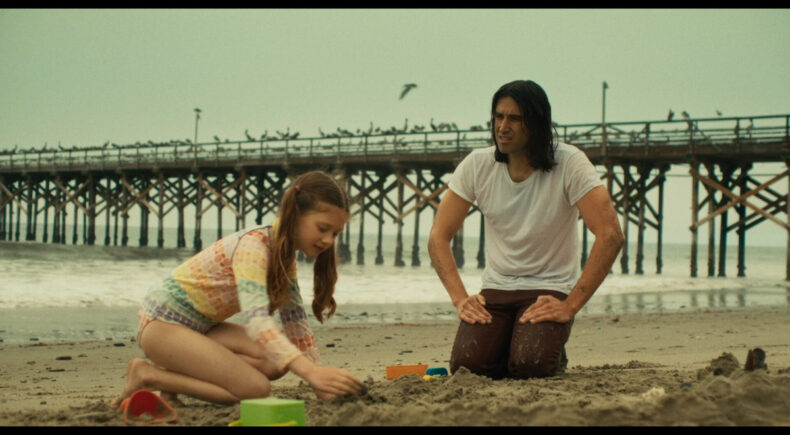
Crystal Cross is the story of two unlikely companions on a doomed but beautiful road trip across America. Dotty, a Christian singer in trouble, believes she’s received a sign from God when she meets James, a man who looks strikingly like Jesus. For Dotty, James is her ride out of town and a chance to reverse her fate. For James, however, the journey has a darker purpose. Broken by the loss of his daughter and after several failed suicide attempts, he is driving cross-country to California to finally end his life.
What follows is an odd-couple love story — not quite a romance, but a connection that grows out of desperation, humor, music, and the long miles between them. Dotty clings to her dreams of stardom while hiding a secret that could destroy them both. James, a father without a child and a musician who no longer plays, resists every effort to be saved. As they travel, their bond deepens in strange, contradictory ways: moments of beauty at roadside attractions, recording booths, desert blooms, and drunken spirals reveal both their flaws and their fragile hope.
Crystal Cross explores the absurdity and tenderness of survival, faith, and failure in modern America. It is both a darkly comic odyssey and a meditation on love in its rawest form — love that doesn’t fix or promise, but simply keeps you alive for one more mile.
The film features an original 15-song soundtrack written by Richie Follin, blending story and music into a singular cinematic journey.
It stars Rubyrose Hill (Girls tv series), Richie Follin, Lukas Haas (Inception, Witness), Missi Pyle (Gone Girl, Charlie and the Chocolate Factory), Samantha Robinson (The Love Witch, Once Upon a Time in Hollywood), Luke Baines (The Girl in the Photographs, A24's Under the Silverlake), Kayla Anjali (The Pitt), Eric Kelly (The Daily Show, The Eric Andre show), David Lowe (Midnight in Paris) and Barbara Willams (CSI, Mayans M.C.).
About the director
Richie Follin is an award winning American musician, writer, actor, filmmaker, and a proud citizen of the Cherokee Nation. A longtime collaborator of Michel Gondry, Follin began writing music at 12 after watching his stepfather Paul Kostabi (founding member of White Zombie) record with Dee Dee Ramone. He worked at his uncle’s art gallery in New York City while growing up, taking large-format slide photographs to catalogue the art.
He came to prominence in 2001, at the age of 18, after releasing a 7-inch record on legendary punk label Posh Boy Records (Black Flag, Agent Orange). Shortly after, Gondry directed a music video for him and featured his music in the soundtrack to Eternal Sunshine of the Spotless Mind, beginning a creative relationship that would continue throughout Follin’s career.
Follin has toured the world and released music with The Willowz, Cults, CRX (with members of The Strokes), and Guards. He has scored multiple documentaries for CNN and ESPN, as well as commercials and major campaigns for brands including Chevrolet, Vice, HBO, Pepsi, and Wal-Mart. As a filmmaker, he has directed music videos and short-form documentaries for artists such as The Hives and Christopher Owens (of Girls). In 2025, he wrote and directed his debut feature film Crystal Cross, accompanied by a soundtrack of original songs inspired by the film. Crystal Cross premiered at Austin Film Fest 2025 and won the Audience Award for Best Comedy.
“My career in music is tied to film. I made my first record at 18 while studying film in college, and shortly after that I received an email from Michel Gondry asking to use my music for his film Eternal Sunshine of the Spotless Mind. I wanted to go to film school, but I began the life of a touring musician and had to drop out. When I think of music, I think of film. They are inseparable for me, and that is what led me to writing and directing a film.
“My family is from California by way of Oklahoma, and we are related to the old Okie Cherokee cowboy actors Will Rogers and Clu Gulager. So, I grew up with my grandmother taking me to auditions as a child. I would never get the part because I would always change the lines to what I thought they should be. This was a horrible method of beginning an acting career, but a great method to begin screenwriting.”
Filmmaker's note
Crystal Cross draws from my own experience of driving across America, contemporary American culture, Christianity, oddball love, as well as what being a professional musician can mean at times. Most importantly, it expresses what it feels like when you can’t go on, and when you do, finally, miraculously, find a way to crawl up and out of a deep hole. It tells a story of faith in the face of oblivion. The film attempts to reconcile a modern dilemma—it's about people with irreconcilable differences finding a way to connect beyond their beliefs about religion or politics. I believe at its core it is simply the story of a girl fighting on for the life she wants.
The real seed of Crystal Cross was planted about fifteen years ago. I was working as a PA on a commercial with production designer Sammy Lisenco, who invited me to a small screening of a new film he had worked on — the Safdie brothers’ Daddy Longlegs. It was in a tiny screening room in a New York hotel, and watching that film was a lightbulb moment for me. Seeing people just go out with a camera, using real locations and non-actors to make something raw and alive, changed how I saw filmmaking. That night, I went home and wrote a treatment for Crystal Cross and sent it to Sammy. Fifteen years later, I finally sent him a link to the finished film.
During pre-production, I thought up ways to make a small budget seem big, and one of those ways led to the film becoming a road movie. I thought of all the stops I loved from touring across America over the years and called in some favors from my favorite roadside attractions and restaurants. I found filmmaking to be much more collaborative than my experience touring in bands. People from all over the country came together to help us for nothing more than their love of film. Ironically, making this film about a guy who wants to kill himself has truly restored my faith in humanity.
I hope my experience making this film inspires others to go out and make their own films.