


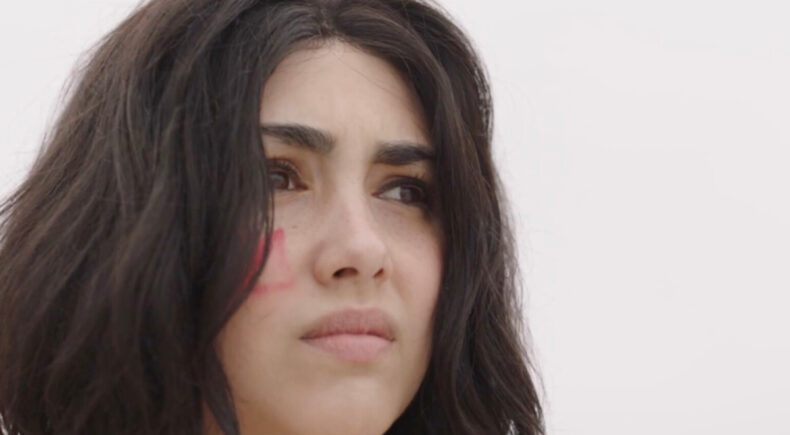
HEADBANG
Director: Anna Khaja
Cast:Alexa Mansour, Purbi Joshi
Crew:Writer: Anna Khaja. Producers: Raelle Tucker, Cameron Fife.
Email:annakhaja@gmail.com
Synopsis
An American perspective on the hijab and female empowerment that resonates with universal questions of selfhood and freedom. Through the lens of two different young women, Leila, from secular background, and Amara, from a religious one, HEADBANG explores the complex power of the hijab, and how a seemingly simple piece of cloth embodies both what the wearer imbues it with and what society project onto to it.
About the director
Anna is a Pakistani-American, Muslim-American multi-hyphenate. She is the recipient of the Google x Black List Storytelling Fellowship (2022) and the Grand Prize Winner of Screencraft’s Pilot Competition (2023). Her play SHAHEED: The Dream and Death of Benazir Bhutto (written and performed by Khaja) had an acclaimed and extended Off-Broadway run in NY, as did her recent Off-Broadway stint In FATHERLAND at MTC in NY.
Anna is also a well-known actress with a strong Film and TV presence and recurring roles on 'The Good Place,' 'The Walking Dead' franchise, 'The Lincoln Lawyer,' 'Silicon Valley, “Madam Secretary,” to name a few. She also stars as Jaya in the Netflix feature 'Definition Please' written/directed by Sujata Day and produced by Ava DuVernay.
Early in her career, Khaja portrayed one-dimensional representations of voiceless Muslim women. Now, she tells her own stories about complicated Muslim females who ultimately define themselves.
HEADBANG is her directorial debut. She is currently in pre-production on her first feature “Bhai” (“brother” in Urdu).
Filmmaker's note
At the heart of FEMALE MUSLIM IDENTITY lies the question of the hijab – a topic that is often avoided or misunderstood. This simple piece of fabric holds immense meaning: for some, a symbol of religious freedom; for others, a mark of oppression. It has long been a symbol of controversy, sacredness, “othering,” and defiance. With HEADBANG, I invite a deeper conversation about the complex truths surrounding the hijab and self-determination.
HEADBANG is a deeply personal film for me: a reflection on my teen years as a Pakistani woman in small town America. My father hid me from our family in Pakistan, including his twin, until I was 30. This experience created a schism in my relationship to Islam and divided my identity perhaps forever. I am still trying to reconcile the voices at war within me.
Then, my personal schism went "meta"...
When I first started acting in tv/film the only roles available to me were those of hijabi women, often portrayed as voiceless, oppressed, or radicalized. Now, as an actress with 85 film and TV credits, I’ve witnessed firsthand how popular media continually distorts the portrayal of Muslim women and their relationship with the hijab. While I identify as Muslim, I am not a hijabi. But through the roles I played, I wore the hijab often, sometimes for weeks at a time. I experienced how it changed my perception of the world: I felt more private in public, more relaxed in my body, and, at times, didn’t want to take it off. One hijabi shared, “When I wear my hijab, people listen to me more. I feel respected.” Another said, “It reminds me to be my kindest self in the world.” However, a former hijabi spoke of regret, saying, “It dimmed my light.”
Then...all my hair fell out. It was the result of a medical treatment, but I could never have predicted the identity crisis that followed. Without my hair, I no longer recognized myself. I began to understand, in a visceral way, the complex relationship between women, hair, and the male gaze. I felt deeply unattractive and unworthy, as if I had lost not just an aspect of my appearance but something essential to my sense of self.
Only then was I ready to make HEADBANG, which I myself directed while wearing a wig.
Women. Hair. The male gaze. Self-dermination.
HEADBANG is about women and our struggle for freedom: physical, mental, and spiritual. The two protagonists begin their journeys feeling trapped but find liberation through their own choices. The film highlights the complexity of Muslim women’s experiences, showing that we are not a monolith, but individuals with unique relationships to Islam, our bodies, and our identities.